
Upgrading a Neco 892 autopilot
Updated: Jun 30
Neco Marine Ltd, based in Havant, UK was a pioneer in commercial and yacht autopilots. The company gained international recognition in the 1960s to 1980s for its heavily engineered systems. The Neco 892 autopilot is a sophisticated navigation system designed primarily for small commercial vessels such as fishing trawlers and pilot boats. Many of these units were fitted to Nelson boats, particularly those with mechanical steering systems.
Five individual components make up a typical installation:-
892CU control unit fitted to the vessel dashboard
892PSU power supply and distribution board
S189 rudder feedback unit
DC reversing motor with integral electric clutch
NM3 fluxgate compass
In the early 1990's Neco Marine's assets and designs were absorbed into Navitron Systems Ltd who continue to manufacture commercial grade autopilots. Their range of products can be found on the company's website https://navitron.co.uk/

Having decided to upgrade my autopilot, I selected the Navitron NT777 MK2 autopilot as a suitable replacement for the Neco 892. The unit is compact and capable of being interfaced with my existing rudder feedback unit, compass and motor. It resembles the old unit but now has an LCD display and tactile buttons to adjust digital settings instead of rotary dials.
The NT777 can receive track data from a GPS or chart plotter and there is a also wide range of optional equipment which can be connected to it.

I decided to keep my existing NM3 fluxgate compass so the first task was to identify the five wires coming out of it. The compass operates on two completely separate DC circuits to communicate heading information to the control unit:-
Circuit 1 (2 wires) connect the mono-phase exciting coil, usually white and red
Circuit 2 (3 wires) connect the three-phase receiver coil, usually yellow, green and blue
Resistance across white and red should be roughly 4 ohms
Resistance across any pair in the yellow/green/blue group should also be roughly 4 ohms
There should be an infinite resistance (open circuit) between any wire in Circuit 1 and any wire in Circuit 2

*Note:
If the compass heading reads in the reverse direction (turning to port increases the reading) then swap over the connections for two of the phases (for example, 42 with 43).
The second task was to connect my existing S189 rudder feedback unit, it has seven wires coming out of it but as you can see above there are only six terminals (48 to 53) on the distribution board. Turns out that modern units have a common 12V connection to both limit switches whereas the old units had separate feeds.
The other consideration is which way the rudder feedback arm moves when you turn the helm to starboard. The wiring connections on the S189 unit itself must be set up correctly as shown in this excerpt from the 892 installation manual:-

My feedback arm moved in direction A (Condition 1) so here is how I connected it:-
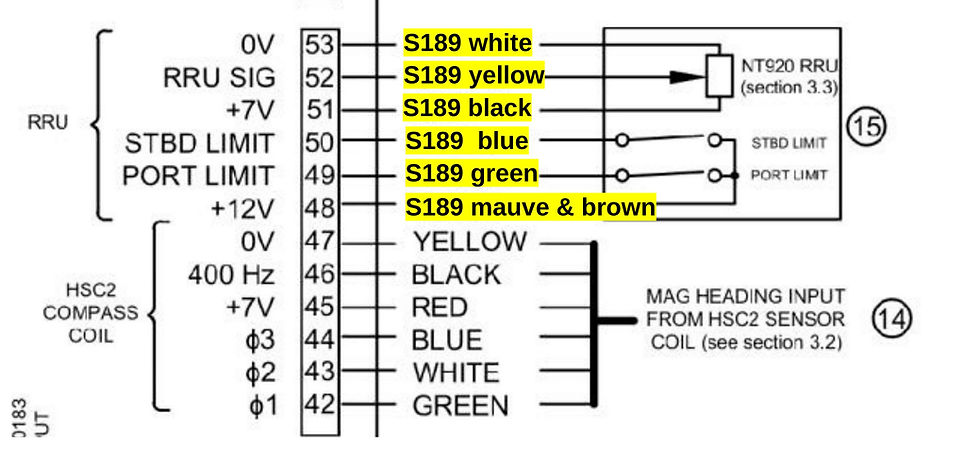
Lastly, the integral clutch on my DC reversing motor needs to be engaged whenever the autopilot is switched from "Standby" to "On". The distribution board has a status relay which can be used for this purpose (terminals 13 to 15).

I hope this article is helpful to any Nelson owners out there thinking of upgrading their old Neco autopilot. If you want any further information then click on Contact Us at the bottom of the web page and send me a message.
Disclaimer:
The above information has been compiled in good faith by the author, however it should be treated as informal advice and should not be considered exhaustive or relied upon.
Author:
Paul Gamsa


Comments