
Nelson Rally - Paris 2009
The River Seine - An Impression
Although I have been interested in geography since I was at school and am almost a fanatic about maps and charts, I had somehow acquired a completely mistaken idea of the nature of the River Seine. I had supposed that it was much like the River Thames below London - a bleak waterway winding through extensive mud banks, enclosed by high flood barriers and set about with heavy industry. The Nelson Rally of June 2009 revealed therefore a considerable surprise as we took Windrift in company with the other four boats past Honfleur into the Seine. After the belt of fog that assailed us until we reached the Tancarville Bridge, we had almost unbroken sunshine and light winds for the rest of the way to
Paris, that gave us perfect conditions for seeing and enjoying our surroundings.
The first surprise was the extent of the bold hills clothed in deciduous woods that are seldom absent from view on one side or the other of the river, these hills sometimes displaying bold outcrops of chalk or limestone. Indeed trees are one of the most distinctive features of the passage, they are almost always present along the banks, providing a discreet insulating fringe separating the river from the roads, railways and housing that exist not far from the river for much of the way to Paris. One might even criticize the Seine for having too many trees, as the glimpses of cultivated fields or open grassland that are the characteristic of English rural views were noticeably and regrettably absent.
Remarkable also was that there were almost no mud banks, even at low tide when we entered the river; indeed it was not obvious that it was tidal at all, except for the strong and very helpful flood tide that carried us all the way to the first lock at Amfreville 25 miles above Rouen. Also absent from the 85 mile tidal section was any presence of, or provision for leisure boating, that seems a real waste of a superb facility. This situation was not much better on the non-tidal section either, except for the area around Conflans Ste Honorine and much of the river banks from there to Paris where large numbers of superannuated peniche motor barges have been converted to houseboats - sometimes on a sumptuous scale, but still very little active boating.
The River Seine is said to be a very busy commercial waterway, and it is true that there is quite a lot of industry scattered along its huge length, and that much of that industry was served by barges. But even in France there are many signs of decaying industry, with many disused quays and some derelict factories, just as it was in England two or three decades ago. But although there is still a significant trade for sea-going ships and inland waterway barges, the latter often running as tandem pairs, the traffic is not enough to cause the leisure boater any anxiety. Much of the remaining trade is sand and gravel dug in the Seine Valley for the many building projects that still seem to be going on; so much so that one may be forgiven for wondering if the French eat stone and concrete, a supposition that might be supported by trying to eat their bread!
But perhaps the aspect of the Seine that I was least prepared for was the sheer size of it. It is one thing to see on the chart that it is 192 nautical miles from Honfleur to Paris, but it does not really register until one spends four days making the journey, and realizing that it is longer than the entire navigable length of the Thames from Lechlade in Gloucestershire to Sheerness in Kent. But such is the beauty of the scenery, the interest of the surroundings and the novelty of navigating such a long waterway that we never lost interest or enthusiasm on the way to our destination - Paris. Our arrival there was a fitting climax to the journey with its multitude of variegated bridges, fine buildings and statuary that lined the banks, notwithstanding the pressure of tripper bateaux mouches that ply so thickly in the city. The journey was every bit as rewarding as I had hoped, and far exceeded my very modest and inadequate previously held conceptions. The enjoyment was also very much enhanced by travelling in company with the Nelson Fleet, punctuated by much badinage on the radio, and lead so ably by Paul Gamsa in Seiren.
The Other Way Home
It had been our intention to trickle gently back down the Seine in Windrift stopping at several places to see a bit more of the towns and villages as we made our way home. But Paul sprung on us the idea of going back by a different route: the Rivers 1'Oise and Somme and the Canal du Nord that linked them. My first reaction was 'No!' because I knew that Ruth hates locks, the seven locks to Paris were bad enough, but to add 35
more seemed very unlikely to appeal to her, and a one kilometre tunnel was certain to make it an impossible option. But to my complete surprise Ruth said 'Good idea' - she can still amaze me after nearly 40 years. So on Monday, after our all too brief, very hot and rather uncomfortable stay in the Paris Arsenal Basin, Seiren and Windrift locked out at 0800 hrs to meet up with the fuel barge, refill our tanks and away through the one-
way system past the Isle de la Cite.
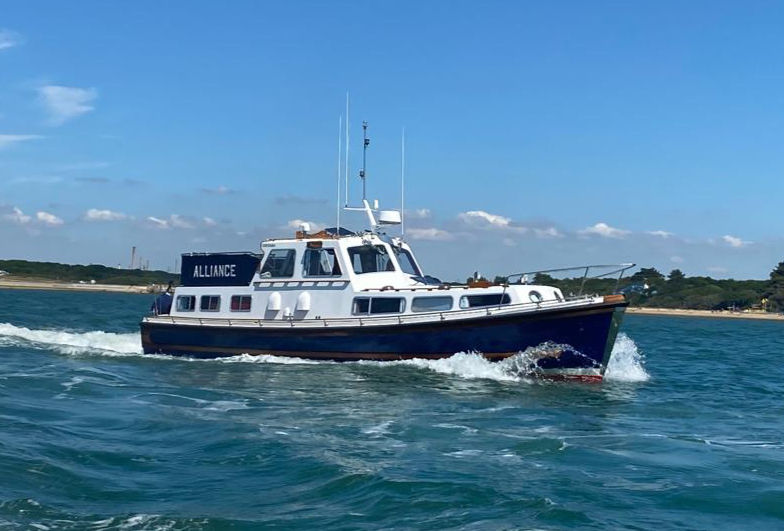
Seiren and Windrift were a slightly odd couple, Seiren being very much an original seagoing pilot boat navigated by Paul Gamsa on his own, while Windrift is much smaller at 32 feet and built as a yacht in 1972 with her original Perkins engines. The first 43 miles were back down the Seine to Conflans Ste Honorine where we turned northeast into the River 1'Oise. This was for the first few miles like a slightly smaller version
of the Seine with a good deal of commerce on the banks and barges at work. But we stopped after just five miles at a small private marina at Cergy that provided better facilities than any that we found on the Seine; not so surprising when we found that it was by the same designer as the famous Port Grimaud in the Mediterranean.
As we proceeded the next day the river became steadily more rural and the locks, still fully manned, of a more domestic size than those on the Seine. We made a happy couple of boats navigating these waters, I read the chart and relayed the relevant information by radio, and Paul performed the tricky task of notifying the locks of our approach, he was also a very considerate companion who appeared at intervals with bread
and cakes from bicycling expeditions to local towns and villages. We also adopted the pleasant practice of stopping at a suitable spot for lunch, this reduced the sense of haste and enhanced the holiday atmosphere without prejudicing our rate of progress; indeed we managed 48 miles and seven locks that day. We spent the night at the interesting town of Compiegne where we failed to find space in the tiny and unattractive
marina, but lay comfortably at the town quay with several other yachts of various nationalities.
The next section was quite short and mostly canal so speed was much reduced, so much indeed that it proved a bit difficult for Seiren, although comfortable for Windrift with one engine shut down. And having climbed through a couple of locks it was a pleasant change to look down on the surrounding country from above, rather than always see it from the bottom of the valley. We stopped for the night at what was optimistically called the Public Port of Noyon, this was no more than a slight widening of the canal with a quay and bollards that obviously saw little use, although there was a large grain depot there. Paul activated his two folding bicycles and he and I went into the city a couple of miles away and bought ice creams to cool us on the very hot afternoon before visiting the huge and famous cathedral (Such was the success of this and other
expeditions that a folding bicycle has been added to Windrift's cruising inventory).
The next section, also of canal, took us 24 miles, five locks and the tunnel to Peronne. The tunnel was lit, but so bright was the sunshine outside that we could have done with more light, and I had forgotten to uncover my searchlight and it was too late once we were inside. But no harm was done to either boat, the traffic was controlled by traffic lights and the tunnel built big enough to take an empty peniche, so plenty of room for a
Nelson. In fact it was altogether less of an anxiety than I had expected, never having navigated a tunnel before. Paul later bought an industrial floodlight (at a knock down price) for his long tunnel passage and I understand was a great success.
At Peronne we found a delightful berth in a short arm of the canal that had been fitted with pontoons, with water and electricity laid on, as an adjunct to an attractive and well-equipped caravan site on the outskirts of the town. The major attraction being a swimming pool that saw quite a bit of use in the continuing heat of the two days we were there. At this point Seiren and Windrift parted company; Paul heading North along the
canals to Belgium that included the formidable four kilometre tunnel, and so to Holland where Seiren was to await the Dutch NBOC meeting in September. We were sorry to wave goodbye to Paul and Seiren as they had been such amiable companions ever since our arrival at Le Havre. He had taken much trouble to ease our passage and faultlessly executed the unenviable task of Cruise in Company Commodore.
Windrift turned into the Somme river and entered a new world that seemed like a set for the film of 'The African Queen', indeed we wondered if it was even the right river so narrow and overgrown was it. And when we reached the unmanned first lock we failed to persuade it to come to life. So after some fruitless efforts we turned round and returned to the canal where fortunately we met two Belgian motor boats on their way to the Somme, so we turned round again and followed them. They had a better understanding of the idiosyncrasies of the lock and between us we managed to get it to wake up, and so passed into a gradually improving river to sign on with the Authority at the next swing bridge. From there the efficient Somme staff travelled from lock to lock in an ubiquitous orange van to let us through each in turn - with a suitable break for their lunch – and there was ample room for the three of us in the locks, although these were the next size down from those on the Oise. By agreement between us we pushed on quite hard up to, or -1 confess - quite a bit beyond the very modest permitted speed limit of three and a half knots. By doing so we were just able to reach the last of the ten locks above Amiens at closing time and we were thankful to the sympathetic young man who let us through just after it should have closed. We were therefore able to reach the city for the night and moored at the town quay free of charge in the unlikely company of two English narrow boats that were kept by their owners on the French waterways.
Amiens is a fine city on a small hill above the river crowned by its world-famous cathedral, but the next day being Sunday we did not see much of the life of the place. But for a future visit we were fascinated to note that around the city there is a huge area of what are called Hortillages - small allotment type gardens of flowers and vegetables divided up by a maze of little waterways navigated by small punts. The next passage was just as easy with six locks that took us, on our own now, through gentle country on the little used river that was well maintained even though it now has no commercial traffic. We found that much European money was being spent upgrading the facilities, and only in one place did we find serious weed growth that only just left a clear channel. We spent the next night at the small village of Pont Remy that was supposed to have all facilities, but these seemed to amount to a small quay, a water tap and electricity.
The following day brought us through two more locks to Abbeville where we stopped at a huge crumbling quay, but found the place looking run down and indeed apparently little changed from when I passed through 45 years ago. There remained then only the long straight canal, with swing bridges that were opened for us in sequence by the ever efficient Somme staff, and led us St Valery sur Somme where there was a convenient pontoon above the sea lock, so newly installed that it still lacked water and electricity. There we waited for two days for the wind to ease before going to sea, and there we ran out of Calor gas - not replaceable in France - but we had been prudent and had a small portable stove in reserve. The Somme had been a very pleasant interlude and much to my liking, but it would be unlikely to suit boats that have difficulty in travelling slowly enough, and it may be too rural for some tastes. Rather like my home town of Yarmouth in the Isle of Wight - nothing seems to happen!
On 08 July we went through the sea lock and out into the large very shallow Somme Bay that dries completely at half tide. The approach to, and departure from St Valery is a considerable hazard as the channel is narrow and very tortuous, it also changes frequently, so although well marked by buoys they are mostly small, unlit and not easy to follow. We had not gone far when the starboard engine boiled up, so I turned back on one engine to the marina at St Valery where I was ashamed to find that I had forgotten to open the seacock after clearing the weed trap. So next day we set off again and reached the sea only to discover that water was over the cabin floorboards. I quickly found that it was warm water and diagnosed a melted plastic joining piece in the exhaust pipe, the result of yesterday's problem. By then, although it was rough and very uncomfortable, we decided not to return to St Valery where one is trapped at all but high tide, so we bashed on for Dieppe on one engine (getting a bit of a habit this!). And a miserable passage it was too, it seemed to take an age and poor Windrift pitched, rolled and was washed over continuously by the waves, and to cap it all we fouled a fishing line at Dieppe Harbour entrance pulling the rod into the water and had to
try and manoeuvre on one engine to retrieve it for the owner.
Fortunately the exhaust pipe was easily repaired thanks to help from a kindly Frenchman who took me in his car to the equivalent of B&Q to buy a short length of lavatory drain pipe that served as a joining piece, and I soon fitted it (cost six euros!). Three days passed while we waited for a window of motor boating weather, and when it came we made a 0430 start for a very comfortable passage to Brighton arriving at 1030. Another
0400 start next day got us home to Yarmouth Harbour at 0930, working the tide on both occasions. And so ended our very enjoyable 2009 Nelson Cruise, full of contrast and novelty. The inland waterways offer much attraction - no worries about tides, weather, rough seas or navigation and comfortable travel at very economical speed. I think I could enjoy a good deal more of it!


Comments